
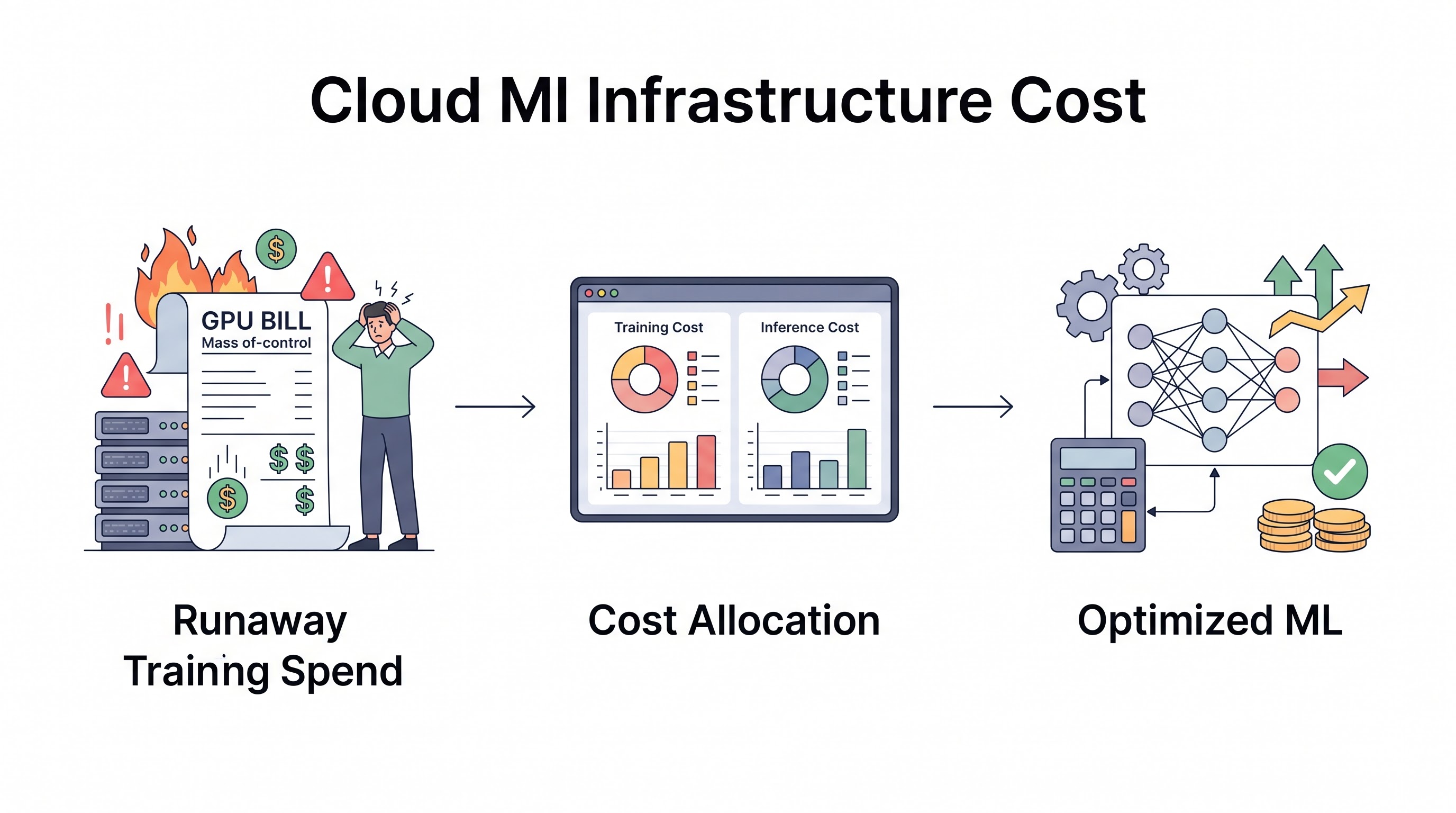
The Hidden Iceberg of ML Costs
When organizations initiate an Artificial Intelligence or Machine Learning (ML) project, the budget discussions usually focus entirely on the cost of the high-end GPUs required for training. This is a critical mistake. Training compute is merely the visible tip of the ML cost iceberg.
A production-grade machine learning system involves a massive, continuous data supply chain. Data must be ingested, cleaned, stored, and processed before a model ever sees it. Once the model is trained, it must be hosted continuously to serve predictions (inference) to users. Without strict FinOps discipline applied across the entire lifecycle, ML projects frequently collapse under their own infrastructure weight.
This guide breaks down the three distinct phases of cloud ML costs and provides the technical strategies required to optimize them.
Phase 1: The Data Pipeline (ETL and Storage)
Machine learning models require massive datasets. The cost of storing and processing this data often rivals the cost of the compute used for training.
Storage: If you dump petabytes of raw, uncompressed telemetry data into an S3 bucket and leave it in the Standard tier, your storage bill will be astronomical. As detailed in the Storage Optimization Guide, you must compress the data (e.g., using Parquet format) and implement strict lifecycle policies to move older training data to Glacier deep archive.
Data Preparation (ETL): Cleaning and transforming data (Extract, Transform, Load) requires heavy compute. Running massive Apache Spark clusters on EMR 24/7 is financially ruinous. Organizations must transition their ETL pipelines to ephemeral, serverless architectures that spin up, process the batch data, and immediately terminate.
Phase 2: Model Training (The Massive Compute Burn)
Training a deep neural network requires running clusters of highly expensive GPUs (like NVIDIA A100s or H100s) at 100% utilization for days or weeks. This is a massive, CapEx-like expense.
The Trap: Data scientists frequently leave training instances running over the weekend while they wait for results, or forget to terminate the incredibly expensive p4d instances after the training job completes, resulting in thousands of dollars of wasted spend per day.
Optimizing Training with Spot Instances and Checkpointing
The single most effective way to reduce training costs is utilizing Cloud Spot Instances.
Spot instances offer spare cloud capacity at up to a 90% discount, but the cloud provider can terminate them with a 2-minute warning. Because ML training is essentially a massive mathematical loop, it is perfectly suited for Spot instances if you implement Checkpointing.
Configure your training script to save its progress (the model weights) to S3 every 15 minutes. If the Spot instance is interrupted, the training job pauses, waits for a new Spot instance to become available, downloads the latest checkpoint from S3, and resumes exactly where it left off. This architecture reduces training compute costs by 70-80% with minimal engineering overhead.
Phase 3: Inference (The Compounding Operational Cost)
Training is a one-time (or periodic) cost. Inference—the act of hosting the model so users can send it data and receive a prediction—is a continuous, 24/7 operational expense. Over a 12-month period, inference costs almost always exceed training costs.
Rightsizing Inference (CPU vs. GPU)
Do not use a sledgehammer to crack a nut. While massive GPUs are required for training, they are frequently overkill for inference.
For many traditional ML models (XGBoost, Random Forests) and even smaller neural networks, inference can be run entirely on cheap, highly available CPUs (like AWS Graviton processors) or specialized inference chips (like AWS Inferentia). Reserving high-end GPUs purely for inference is a massive waste of capital. Aggressively benchmark your model's latency on cheaper hardware. If a CPU can return a prediction in 50ms, and your SLA is 100ms, using a GPU that returns it in 10ms is financially irresponsible.
The Cost of Managed Services (SageMaker vs. EC2)
Cloud providers offer managed ML platforms (Amazon SageMaker, Azure Machine Learning). These platforms drastically accelerate the development lifecycle by providing pre-configured Jupyter notebooks and easy deployment endpoints.
However, you pay a significant premium (often 20-40% markup on the underlying compute) for this convenience. For early-stage exploration, SageMaker is invaluable. But once a model is in high-volume, continuous production, the FinOps team must calculate the ROI of migrating the inference endpoint off the managed platform and onto raw Amazon EKS clusters to eliminate the managed service premium.
Key Takeaway
Optimizing ML infrastructure requires addressing the entire lifecycle. Slash data pipeline costs via compression and serverless ETL. Reduce the massive compute burn of Model Training by implementing Checkpointing and aggressively utilizing 90%-discounted Spot Instances. Finally, recognize that Inference is your highest long-term cost; rightsize your hosting by shifting from expensive GPUs to custom inference chips (like AWS Inferentia) whenever latency SLAs permit.
All in One Place
Atler Pilot decodes your cloud spend story by bringing monitoring, automation, and intelligent insights together for faster and better cloud operations.