
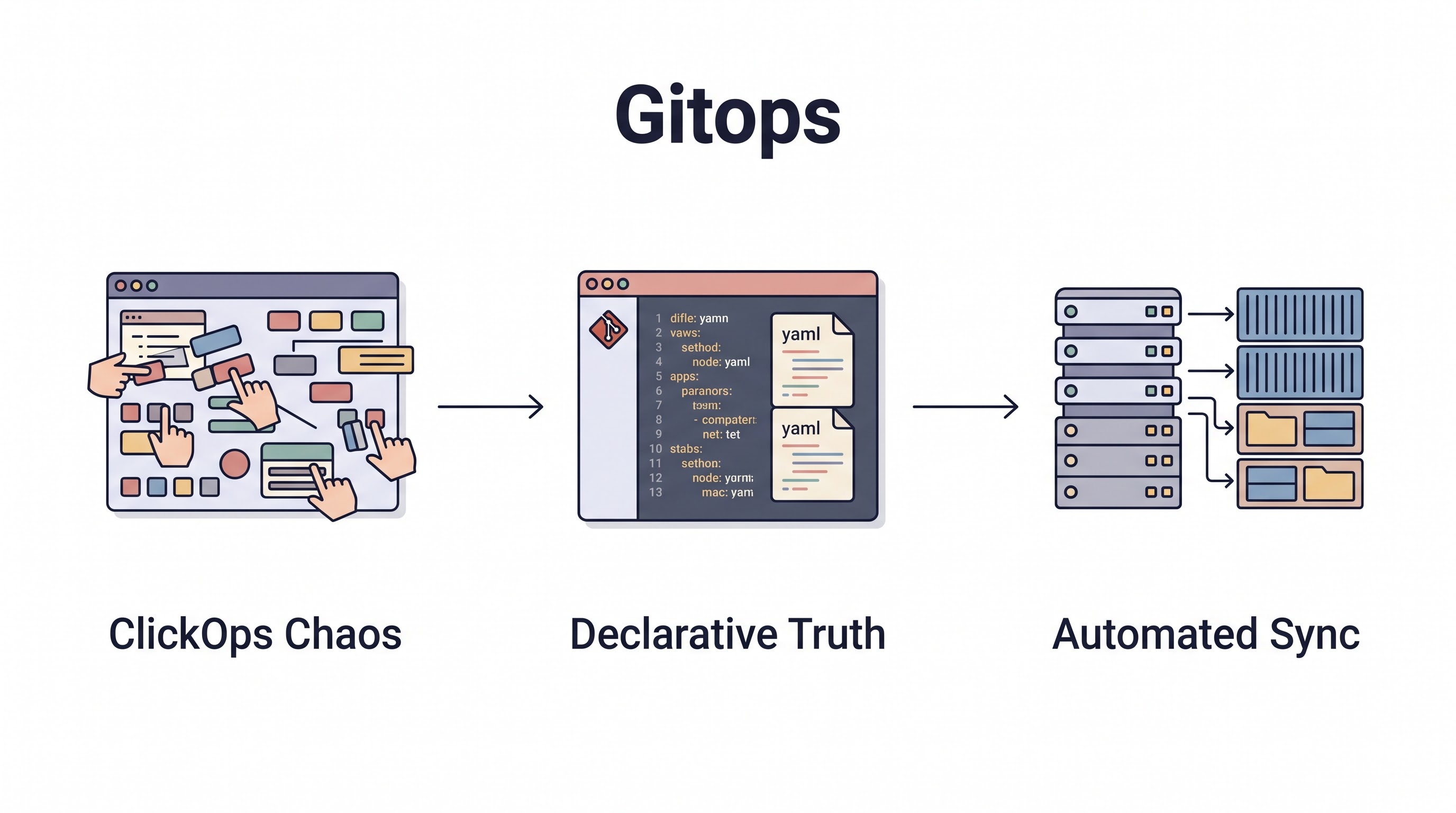
The Configuration Drift Problem
Consider the traditional Continuous Deployment (CD) pipeline. A developer pushes code to GitHub. Jenkins runs tests, builds a Docker image, and then executes a kubectl apply command to push the new application manifests directly into the Kubernetes cluster. This is known as a "Push" model.
The flaw in this model is that the CI/CD pipeline assumes the cluster looks exactly how it left it. But what if an SRE logged into the cluster at 2:00 AM and manually altered a ReplicaSet to handle a traffic spike (ClickOps)? The cluster's actual state has now deviated from the desired state defined in the Git repository. This is Configuration Drift. The next time the CI/CD pipeline runs, it will likely overwrite the manual fix, potentially causing an outage. Furthermore, there is no audit trail of who made the manual change or why.
To solve this, Cloud Operations teams have adopted a radical new paradigm for deployment: GitOps.
What is GitOps? (The 4 Principles)
GitOps is an operational framework that takes DevOps practices used for application development (version control, collaboration, compliance, and CI/CD) and applies them to infrastructure automation.
According to the OpenGitOps project, a system must adhere to four principles to be considered GitOps:
Declarative: The desired state of the entire system (infrastructure and applications) must be expressed declaratively (e.g., via Kubernetes YAML or Helm charts).
Versioned and Immutable: The desired state is stored in a way that enforces immutability, versioning, and retains a complete audit trail (i.e., stored in a Git repository). Git is the single source of truth.
Pulled Automatically: Software agents automatically pull the desired state declarations from Git.
Continuously Reconciled: Software agents continuously observe the actual system state and attempt to reconcile it with the desired state in Git.
Push vs. Pull: The CI/CD Evolution
The critical innovation of GitOps is moving from a "Push" CI/CD pipeline to a "Pull" architecture.
In a GitOps model, the Jenkins/GitHub Actions pipeline (CI) still builds the Docker image and runs tests. However, it does not have access to the production Kubernetes cluster. It does not push anything.
Instead, a software agent sits inside the Kubernetes cluster. This agent continuously monitors the Git repository containing the environment manifests. When the CI pipeline updates the image tag in the Git repository, the agent sees the new commit. It pulls the changes and applies them internally to the cluster. This is the "Pull" model.
The Tools: ArgoCD and Flux
The two dominant tools facilitating the GitOps "Pull" architecture are ArgoCD and Flux (both CNCF graduated projects).
ArgoCD: Known for its exceptional user interface. ArgoCD provides a visual dashboard showing exactly what is running in the cluster versus what is defined in Git. It visually highlights drift and provides a one-click button to sync the environments. It is highly popular in enterprise environments.
Flux: A slightly lighter-weight, CLI-focused tool that integrates deeply into the Kubernetes ecosystem. It is highly extensible and often favored by pure Infrastructure as Code purists.
If that 2:00 AM SRE manually changes the ReplicaSet via the CLI, ArgoCD or Flux will immediately detect the configuration drift. Depending on the configuration, the tool will either flag the environment as "Out of Sync" and alert the team, or immediately and automatically overwrite the manual change, forcefully reconciling the cluster back to the state defined in Git.
The Security and Audit Benefits
GitOps drastically improves cloud security posture.
Revoked Cluster Access: Because the agent pulls from Git, your CI server (Jenkins/GitHub Actions) no longer needs administrative API credentials to the production cluster. If your CI server is compromised, the attacker cannot deploy malware directly to production. Furthermore, human developers no longer need
kubectlaccess to production.The Ultimate Audit Trail:
git logbecomes the ultimate audit log for compliance. Every single change to the environment is tied to a specific Git commit, a specific pull request, a specific author, and an approving peer. This makes passing SOC 2 or ISO 27001 audits vastly simpler.Trivial Rollbacks: If a deployment causes an outage, rolling back does not require writing new code or navigating complex CI/CD rollback scripts. You simply click "Revert" on the Git commit. The GitOps agent instantly sees the repository revert to the previous state and downgrades the cluster automatically.
Beyond Kubernetes: GitOps for Infrastructure
While GitOps was born in the Kubernetes ecosystem, the principles are expanding to cover all infrastructure. Tools like Crossplane or Terraform Controllers allow organizations to use the GitOps workflow to provision AWS RDS databases or Azure Virtual Networks. The Git repository becomes the single pane of glass and the ultimate source of truth for the entire cloud estate.
Key Takeaway
GitOps is the operational end state for cloud-native deployments. By using Git as the single source of truth and utilizing "Pull" agents like ArgoCD or Flux to continuously reconcile the cluster state, organizations eliminate configuration drift, revoke dangerous direct access to production environments, and create an immutable, mathematically perfect audit trail of every change ever made to the infrastructure.
All in One Place
Atler Pilot decodes your cloud spend story by bringing monitoring, automation, and intelligent insights together for faster and better cloud operations.