
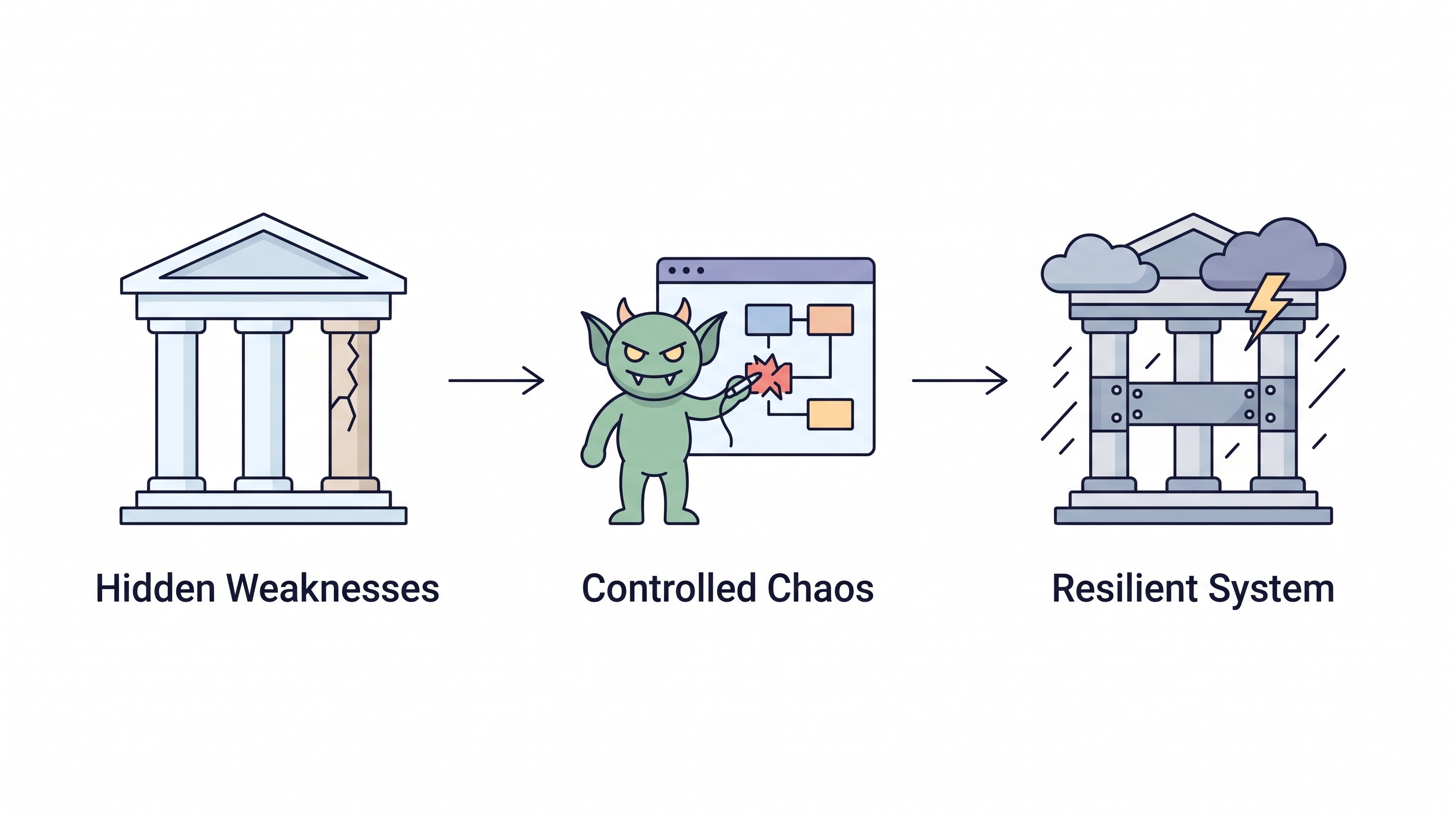
The Fragility of Assumptions
Engineers design cloud architectures based on assumptions. We assume the Auto Scaling Group will spin up new nodes in exactly two minutes. We assume the database will seamlessly failover to the secondary replica if the primary node dies. We assume the circuit breaker will trip if the third-party API latency exceeds 500ms.
On paper, these architectures are flawless. In reality, under the stress of production traffic, these assumptions frequently shatter. The failover script contains a typo. The Auto Scaling Group hits a hidden AWS quota limit. The circuit breaker isn't configured correctly, causing cascading timeouts that take down the entire application.
Waiting for a 3:00 AM emergency to test if your disaster recovery mechanisms actually work is a reckless strategy. To guarantee reliability, you must test these assumptions aggressively. You must break things on purpose. This is the discipline of Chaos Engineering.
What is Chaos Engineering?
Pioneered by Netflix (who infamously created "Chaos Monkey" to randomly terminate EC2 instances in their production environment), Chaos Engineering is the facilitation of controlled experiments to uncover systemic weaknesses.
It is not randomly breaking servers to see what happens. It is the application of the scientific method to distributed systems. By proactively injecting failures (network latency, CPU spikes, node termination, database outages) into the infrastructure, Site Reliability Engineers (SREs) can observe how the system responds and fix the hidden flaws before they cause a customer-facing outage.
The Prerequisites: Do Not Start Here
Chaos Engineering is an advanced practice. If you do not have the basics in place, running a chaos experiment is pointless self-harm.
High Availability Architecture: If you are running your application on a single VM without a load balancer, you don't need Chaos Engineering to tell you that terminating the VM will cause an outage.
Deep Observability: You must have robust distributed tracing and APM in place. If you inject a failure and cannot accurately track how that failure cascades through the microservices, the experiment provides no valuable data.
Incident Management: You must have a mature incident management process to handle the situation if the experiment spirals out of control.
The Chaos Engineering Process
A chaos experiment follows a strict methodology:
Define the Steady State: Identify the metrics that indicate the system is healthy (e.g., "Checkout success rate is 99.9%").
Formulate a Hypothesis: State what you believe will happen. "If we terminate one of the three payment gateway pods, Kubernetes will spin up a replacement, and the checkout success rate will not drop below 99.8%."
Inject the Fault: Introduce the chaos (e.g., kill the pod).
Observe and Measure: Monitor the steady-state metrics. If the checkout rate plummets to 50%, the hypothesis is disproved. A systemic weakness has been found.
Halt and Remediate: Stop the experiment, analyze the data, and create engineering tickets to fix the flaw (e.g., tuning the Kubernetes readiness probes so traffic isn't routed to the new pod before it fully initializes).
Executing Game Days
Chaos Engineering is often executed as a "Game Day." A Game Day is a scheduled event where the engineering, SRE, and security teams gather to run a series of chaos experiments.
Game Days are dual-purpose:
Technical Validation: Proving the infrastructure is resilient.
Human Training: Testing the incident response process. Do the right alerts fire in PagerDuty? Does the on-call engineer know which runbook to use? It is infinitely better for an engineer to learn how to debug a database failover during a Tuesday afternoon Game Day than during a real emergency on a holiday weekend.
The Tools of Chaos (Gremlin, AWS FIS)
Modern chaos engineering rarely involves writing custom scripts to kill servers. The tooling has matured significantly.
AWS Fault Injection Simulator (FIS): A fully managed service that allows you to easily inject faults into AWS resources. You can configure an FIS experiment to randomly terminate EC2 instances, drain EKS nodes, or throttle API Gateway endpoints.
Gremlin: A leading third-party chaos platform that provides a massive library of attacks. It goes beyond simple server termination, allowing SREs to inject specific network latency (simulating a degraded cross-region connection), consume all available RAM (simulating a memory leak), or blackhole DNS requests.
Chaos Mesh: An open-source, cloud-native chaos engine built specifically for Kubernetes, allowing you to orchestrate chaos via custom resource definitions (CRDs).
Controlling the Blast Radius
The cardinal rule of Chaos Engineering is Minimize the Blast Radius.
You do not start by shutting down an entire production database. You start small.
Run the experiment in Staging first. Fix the obvious bugs.
Move to Production, but limit the blast radius. Inject the fault into a single, non-critical microservice, or run the experiment only for internal employee traffic (using header-based routing in your Service Mesh).
As confidence grows, gradually increase the scope of the experiments.
Furthermore, every chaos experiment must have an automated "Abort Condition." If the tool detects that the primary business metric (the checkout rate) drops below a defined critical threshold, the tool immediately stops injecting faults and restores the system.
Key Takeaway
Hope is not a strategy. You cannot guarantee the resilience of a cloud architecture until you test it under duress. Chaos Engineering is the proactive injection of failure to validate architectural assumptions, train engineering teams on incident response, and uncover hidden flaws before they manifest as catastrophic customer outages. Start small, control the blast radius meticulously, and automate the testing of your disaster recovery mechanisms.
All in One Place
Atler Pilot decodes your cloud spend story by bringing monitoring, automation, and intelligent insights together for faster and better cloud operations.