
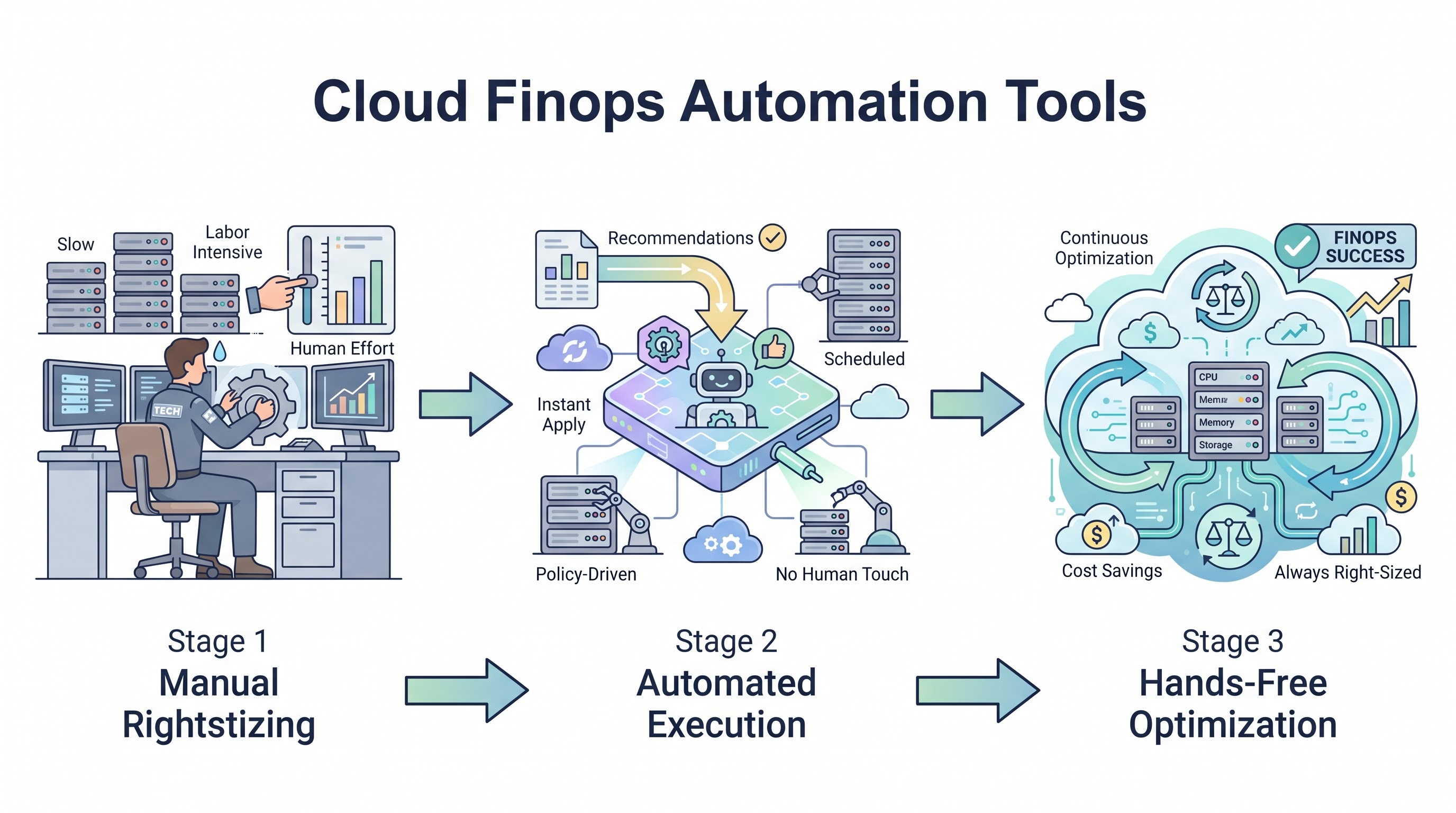
The ROI Gap of FinOps
Many organizations invest heavily in FinOps, standing up centralized teams and purchasing expensive dashboarding tools. They successfully identify hundreds of thousands of dollars in potential savings. Yet, six months later, the cloud bill remains unchanged.
This is the FinOps ROI Gap. Identifying waste is easy; remediating waste requires engineering effort. If a FinOps tool simply generates a list of 500 "overprovisioned EC2 instances" and emails it to the DevOps team, that list will sit in a backlog forever. Engineers prioritize shipping features, not shrinking instances.
To realize actual financial returns, organizations must adopt Cloud FinOps Automation Tools. This guide explores the platforms that move beyond reporting and actually execute the optimization.
Reporting vs. Execution: The Paradigm Shift
First-generation FinOps tools (like AWS Cost Explorer or basic Cloudability setups) are "Read-Only." They pull data from the cloud provider, analyze it, and present it.
Next-generation automation tools (like CloudAtler, ProsperOps, or Spot.io) are "Read-Write." They require IAM permissions to actively modify your infrastructure. This represents a massive paradigm shift. You are shifting the responsibility of optimization from a human engineer to a software agent. This requires deep technical trust, but it is the only way to scale cost optimization in massive, ephemeral environments.
Level 1 Automation: Instance Scheduling
The simplest and most immediate ROI comes from scheduling.
Development and staging environments do not need to run 24/7. An automation tool can be configured to forcefully shut down all non-production instances at 7:00 PM on Friday and turn them back on at 7:00 AM on Monday. This alone cuts compute costs by nearly 70% for those environments. The tool integrates with resource tags (e.g., Schedule: WeekdaysOnly) to execute these commands automatically, completely removing the reliance on developers to remember to hit "Stop."
Level 2 Automation: CI/CD Rightsizing
The next level is automating cloud rightsizing. If a tool detects an instance running at 5% CPU for a month, it should not just alert the FinOps team.
Advanced platforms integrate directly into the organization's Git repository. The tool automatically generates a Pull Request (PR) modifying the Terraform code to downsize the instance from an m5.2xlarge to an m5.large. It includes the historical telemetry data proving the safety of the downsize directly in the PR description. The human engineer only has to click "Merge," reducing the effort from hours to seconds.
Level 3 Automation: Spot Instance Orchestration
As discussed in the Spot Instance Guide, utilizing 90%-discounted spare capacity is highly lucrative, but managing the risk of instance interruption is complex.
Spot automation platforms act as intelligent brokers. When a cluster needs more compute, the automation engine scans the AWS Spot market in real-time, finds the deepest discount with the lowest statistical probability of interruption, and provisions the node. Crucially, if AWS signals that it is going to terminate the instance, the automation engine instantly provisions a replacement On-Demand node, seamlessly migrating the pods with zero downtime. This provides Spot pricing with On-Demand reliability, completely hands-free.
The Final Frontier: Autonomous Commitment Management
Managing Reserved Instances (RIs) and Savings Plans is a complex financial gamble. If you buy a 3-year RI and the engineering team turns off the server after 6 months, you lose money.
Autonomous commitment tools analyze your global compute footprint millisecond-by-millisecond. They autonomously buy, sell, and exchange 1-year and 3-year commitments in the AWS marketplace to maintain a mathematically perfect coverage ratio. As your engineers spin up new architecture, the tool instantly adjusts the financial commitments in the background to guarantee maximum discount coverage without ever locking you into unused capacity.
Key Takeaway
Dashboards do not save money; actions save money. To close the FinOps ROI gap, organizations must deploy automation tools capable of executing infrastructure changes. Begin with low-risk automated instance scheduling, progress to CI/CD rightsizing via Pull Requests, and leverage autonomous orchestration engines to safely utilize highly discounted Spot Instances and dynamically manage financial commitments at scale.
All in One Place
Atler Pilot decodes your cloud spend story by bringing monitoring, automation, and intelligent insights together for faster and better cloud operations.