
The Limits of Spreadsheets
The first generation of Cloud Financial Operations (FinOps) was defined by visibility. Practitioners spent their days wrestling with millions of lines of Cost and Usage Report (CUR) data in Excel, building complex pivot tables to figure out which engineering team spiked the EC2 bill.
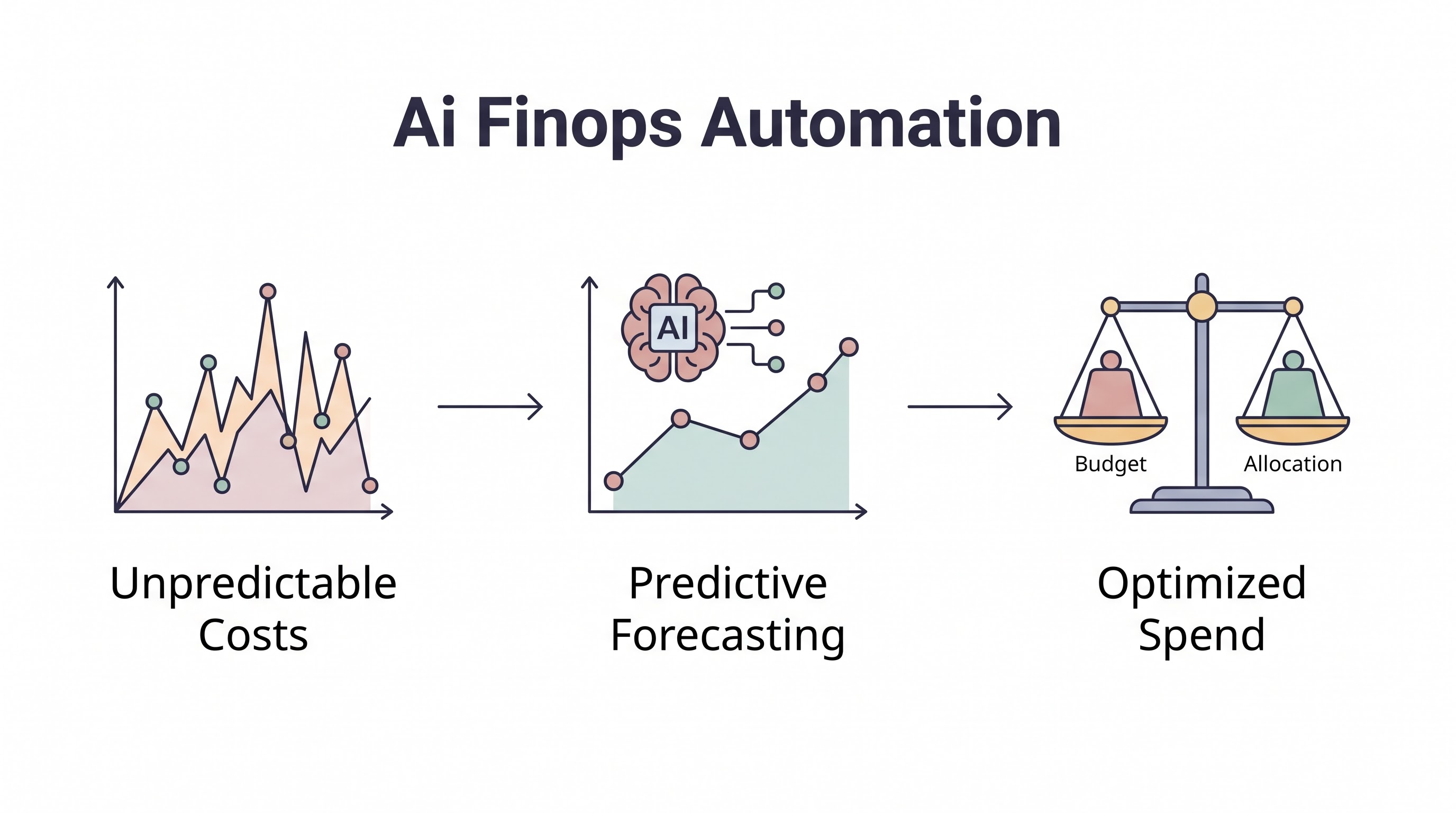
In 2026, human-driven spreadsheet analysis is obsolete. The scale and dynamic nature of modern cloud architectures (ephemeral Kubernetes pods, auto-scaling serverless functions) generate billing data too vast and complex for manual interpretation. To move from reactive reporting to proactive optimization, the FinOps discipline has aggressively integrated Artificial Intelligence and Machine Learning.
This guide explores how AI is fundamentally transforming FinOps, enabling highly accurate predictive forecasting, instant anomaly detection, and autonomous infrastructure optimization.
Predictive Forecasting (Beyond Linear Math)
Traditional cloud budget forecasting relied on simple linear regression: "We spent $100k last month, and we grow 5% a month, so next month will be $105k."
This fails in the cloud because cloud spend is heavily influenced by seasonality, marketing campaigns, and underlying architectural shifts. Machine Learning models excel at identifying these complex, non-linear patterns.
Advanced FinOps platforms train ML models on years of historical billing data alongside external business metrics (e.g., website traffic, daily active users). The AI can predict that a specific retail application's DynamoDB costs will spike by 300% on the third Tuesday of November based on historical Black Friday traffic patterns, allowing the finance team to adjust the quarterly budget accurately months in advance.
Machine Learning for Anomaly Detection
As discussed in the Anomaly Detection Guide, static budget alerts are too slow to prevent billing disasters. By the time a $50,000 monthly budget alert fires, the money is already gone.
AI transforms this by establishing dynamic baselines for every single resource down to the tag level. The ML model learns the normal heartbeat of an application. If an S3 bucket normally incurs $5 of egress fees per day, and suddenly incurs $50 in a single hour, the AI flags it as a high-confidence anomaly instantly. By filtering out the "normal" noise and only alerting on mathematically significant deviations, AI prevents alert fatigue and stops runaway spending in its tracks.
From Recommendations to Autonomous Rightsizing
Cloud providers (like AWS Compute Optimizer) have used basic heuristics to recommend rightsizing opportunities for years (e.g., "Downsize this EC2 instance because CPU is under 10%").
The next evolution is AI-driven autonomous optimization. By analyzing deep observability data (CPU, memory, IOPS, and network latency over months), AI can predict the exact performance impact of changing an instance type. In mature organizations, this is tied into the CI/CD pipeline. When the AI identifies a safe rightsizing opportunity, it automatically generates a Terraform Pull Request to change the instance type. The engineer merely has to click "Approve." This removes the friction of implementation, turning recommendations into actualized savings.
The FinOps Copilot (Natural Language Queries)
Perhaps the most visible impact of Generative AI on FinOps is the introduction of "Copilots."
Instead of requiring a business analyst to write complex SQL queries against a multi-terabyte BigQuery billing export, stakeholders can simply ask questions in natural language: "Why did the data transfer costs for the staging environment increase last week, and which team is responsible?"
The LLM, integrated with the FinOps data platform, translates the natural language into the appropriate query, analyzes the result, and generates a plain-English summary. This democratizes cost data, allowing product managers and non-technical executives to understand cloud unit economics without relying on FinOps specialists to build custom dashboards.
The Risk: Do Not Let the AI Buy the RIs
While AI is exceptional at analyzing historical data and predicting patterns, it lacks business context. An AI might analyze a database cluster that has been running 24/7 for six months and automatically recommend purchasing a 3-Year All-Upfront Reserved Instance to maximize savings.
What the AI does not know is that the engineering team is currently rewriting that application into a serverless architecture and plans to decommission that database entirely next month. If the AI is allowed to make autonomous financial commitments, it will waste thousands of dollars. AI should automate operational tasks (rightsizing, anomaly detection), but massive financial commitments still require human business context.
The Evolution of the FinOps Practitioner
The integration of AI does not replace the FinOps practitioner; it elevates them. By delegating the rote tasks of anomaly hunting, spreadsheet generation, and basic forecasting to Machine Learning, the FinOps team is freed to focus on strategic initiatives: negotiating Enterprise Discount Programs, establishing unit economic KPIs, and driving a culture of cost accountability across the engineering organization.
Key Takeaway
Manual analysis of cloud billing data is no longer viable at enterprise scale. FinOps organizations must adopt AI and Machine Learning platforms to enable predictive budget forecasting that accounts for seasonality, and dynamic anomaly detection that stops runaway spending instantly. While AI can automate infrastructure rightsizing via Pull Requests, human oversight remains critical for long-term financial commitments (RIs/Savings Plans) that require strategic business context.
All in One Place
Atler Pilot decodes your cloud spend story by bringing monitoring, automation, and intelligent insights together for faster and better cloud operations.