
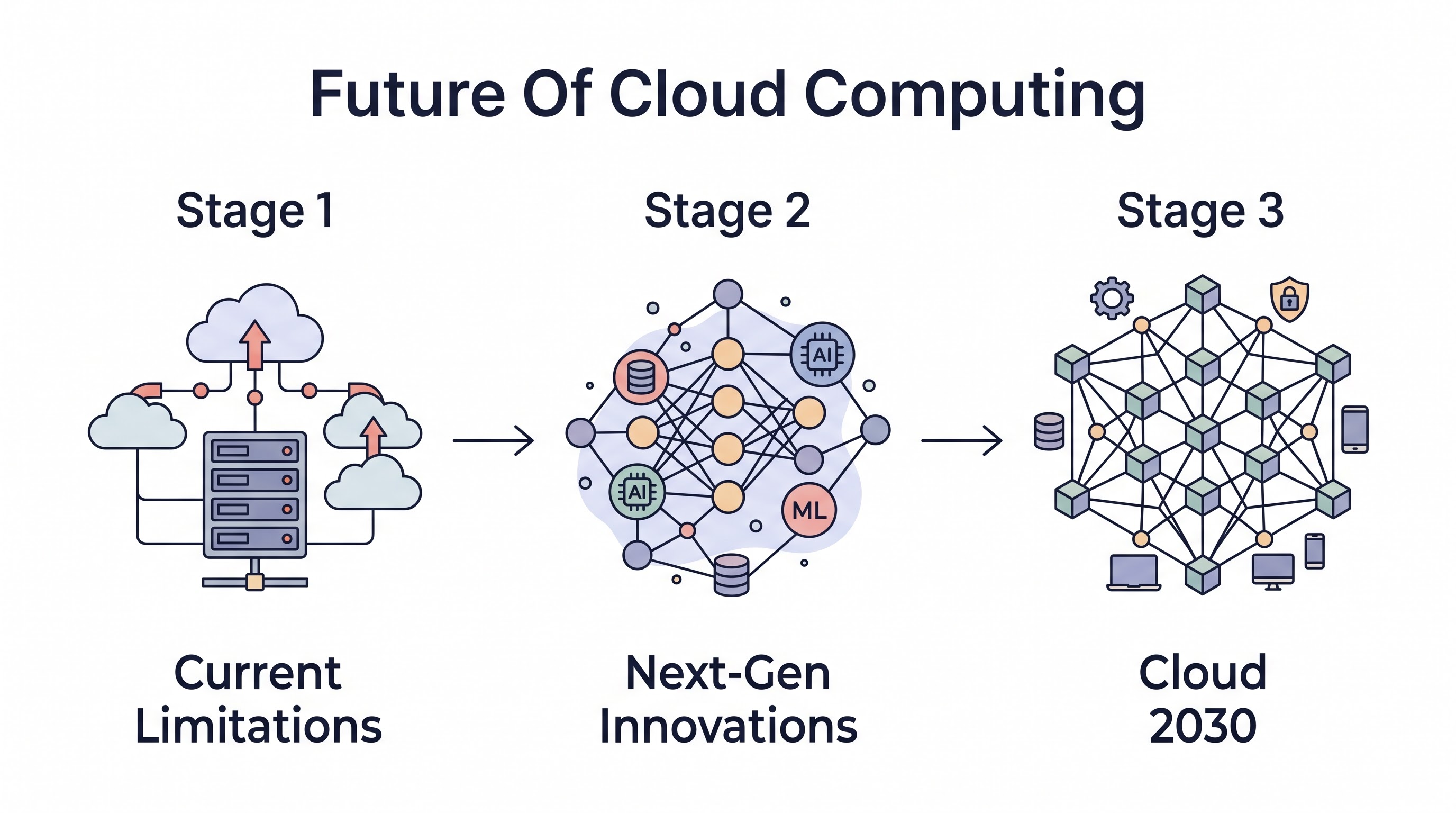
The Next Era of Infrastructure
Over the past fifteen years, the cloud computing industry focused on primitives: migrating virtual machines from basements to hyperscale data centers, establishing reliable block storage, and fighting over container orchestration standards. That foundational phase is effectively over.
As we look toward 2030, the conversation shifts from where compute happens to how it is abstracted. The complexity of managing massive, distributed Kubernetes clusters and deciphering byzantine cloud billing reports is unsustainable. The next era of cloud computing is defined by extreme abstraction, AI-driven autonomous operations, and deep vertical specialization.
This guide explores five strategic predictions for the future of cloud architecture and operations.
1. The Disappearance of Infrastructure (True Serverless)
Today, "Serverless" still requires significant operational knowledge. Developers must configure Lambda memory allocations, manage API Gateway routing, and carefully design DynamoDB partition keys. (See the Serverless Operations Guide).
By 2030, the line between PaaS (Platform as a Service), Containers, and Serverless will vanish. Infrastructure will become entirely invisible to the application developer. A developer will push raw code to a Git repository. The cloud provider's AI will analyze the code, determine the optimal execution environment, automatically compile it, deploy it to a globally distributed network, and scale it instantly based on traffic. The concept of provisioning a "server" or defining an "auto-scaling group" will seem as antiquated as manually assigning memory addresses in C.
2. Autonomous FinOps and SecOps
The complexity of cloud security and cloud economics has outpaced human cognitive capacity. The dashboards are too noisy.
In the near future, FinOps and SecOps will transition from analytical disciplines to autonomous systems.
Autonomous FinOps: AI agents will not just recommend rightsizing; they will execute it continuously in real-time, shifting workloads between compute architectures (e.g., from x86 to ARM) millisecond by millisecond to chase the lowest spot-market price without human intervention.
Autonomous SecOps: When a zero-day vulnerability is announced, AI agents will autonomously scan the entire infrastructure, write the patch, and deploy the fix across thousands of microservices before the security team finishes reading the threat bulletin.
3. The Rise of Industry-Specific Clouds
AWS, Azure, and GCP provide horizontal primitives (compute, database, network) applicable to any business. The next wave of value is vertical specialization: Industry Cloud Platforms (ICPs).
We will see the widespread adoption of "Cloud for Healthcare," "Cloud for Retail," or "Cloud for Financial Services." These platforms will provide pre-packaged, highly opinionated architectures. A bank will not build a transaction database from raw EC2 instances; they will purchase a "Financial Ledger Service" from the cloud provider that is pre-certified for global banking regulations, inherently sovereign, and optimized specifically for financial data models.
4. WebAssembly and the Pervasive Edge
As detailed in the Edge Computing Guide, processing data in a centralized Virginia data center is too slow for autonomous systems and IoT. WebAssembly (Wasm) will become the dominant compute standard for the Edge.
Because Wasm modules are tiny, hyper-fast, and deeply secure, they will allow developers to write code once and have it execute seamlessly across the entire continuum: running in the user's browser, executing on a 5G cell tower micro-datacenter, and failing back to the central hyper-scaler, providing a true "run anywhere" architecture that Java promised decades ago.
5. The Abstraction of Multi-Cloud
Currently, building an active-active multi-cloud architecture requires maintaining two entirely different engineering teams. By 2030, this friction will be abstracted away by a new layer of control planes.
Technologies like Crossplane and advanced Service Meshes will evolve into "Meta-Clouds." An organization will interface entirely with the Meta-Cloud, defining their desired infrastructure using a single universal standard. The Meta-Cloud control plane will automatically translate that configuration and deploy the resources across AWS, Azure, and GCP simultaneously, negotiating prices in real-time and routing traffic based on the lowest latency and cost, commoditizing the underlying hyper-scalers.
The Developer Focus
The overarching theme of the future cloud is the liberation of the developer. The past decade forced developers to become part-time systems administrators, networking experts, and security analysts. By 2030, autonomous AI operations, Wasm, and extreme abstraction layers will push infrastructure back behind the curtain. The only metric that will matter is how fast an organization can translate a business idea into deployed code.
Key Takeaway
The future of cloud computing is characterized by the total abstraction of underlying infrastructure. Developers will focus entirely on business logic, while AI-driven autonomous platforms handle continuous FinOps optimization, real-time security patching, and global deployment across a seamless Cloud-Edge continuum powered by WebAssembly. Organizations must begin investing in Platform Engineering today to prepare for this highly automated future.
All in One Place
Atler Pilot decodes your cloud spend story by bringing monitoring, automation, and intelligent insights together for faster and better cloud operations.