
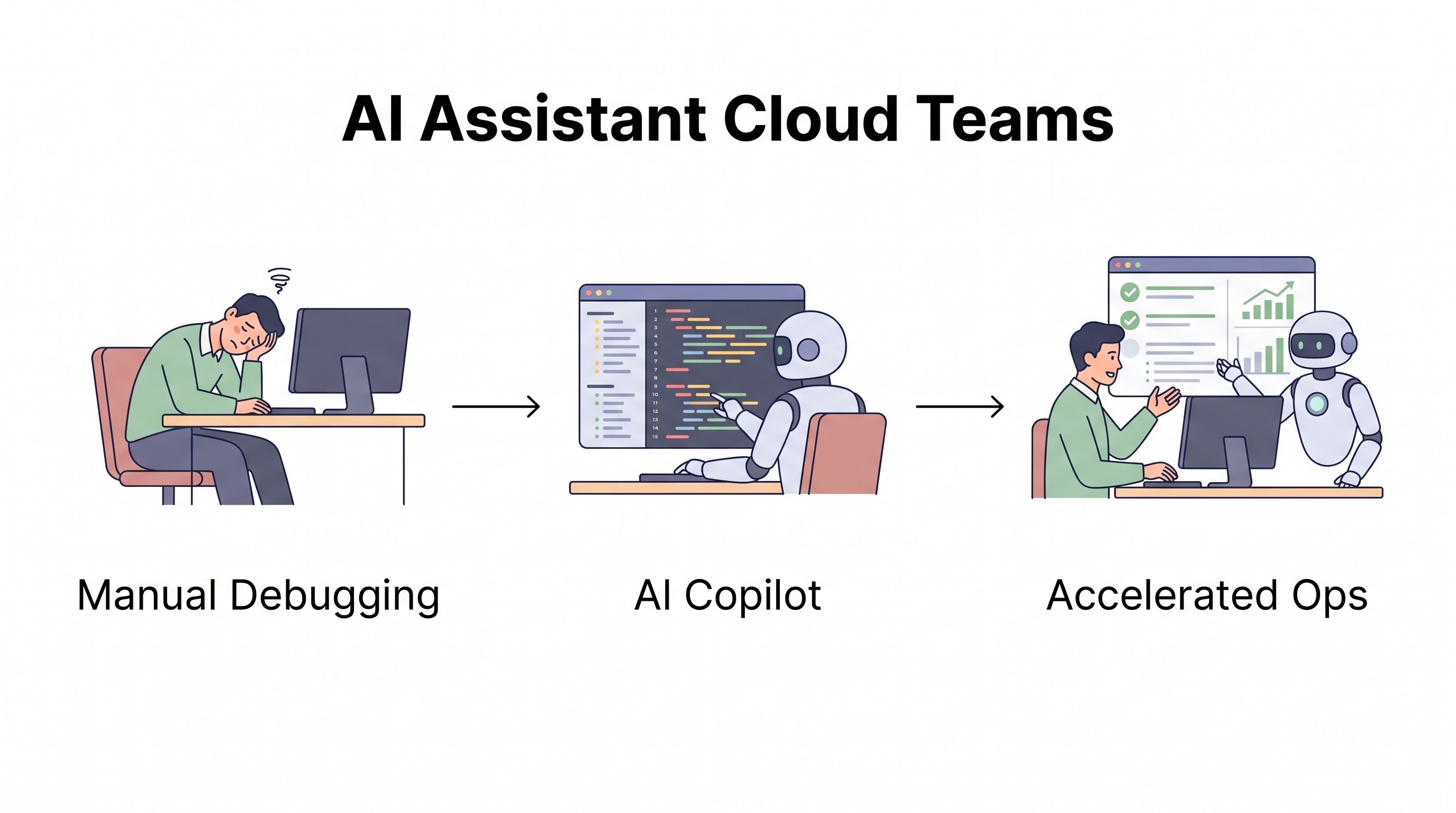
The Rise of the Cloud Copilot
For the past decade, cloud engineers and Site Reliability Engineers (SREs) have operated in a state of high cognitive load. Navigating the sprawling AWS console, deciphering cryptic Kubernetes error logs, and writing thousands of lines of boilerplate Terraform code leads to massive burnout. The cloud operations model was ripe for disruption.
That disruption has arrived in the form of Generative AI Assistants. Tools like GitHub Copilot, Google Gemini, and AWS Q are no longer just completing Python scripts; they are being deeply integrated into the entire cloud management lifecycle. This guide explores how AI assistants are fundamentally shifting the daily workflow of cloud teams, turning junior engineers into senior operators and allowing senior architects to scale their expertise.
Beyond Code Generation: Infrastructure as Code (IaC)
The most immediate and obvious impact of AI assistants is in the realm of Infrastructure as Code (IaC). Writing Terraform or AWS CloudFormation templates is notoriously tedious and prone to syntax errors.
Modern AI copilots understand the syntax of HCL (HashiCorp Configuration Language) deeply. An engineer can simply type a comment: # Create an AWS S3 bucket with strict public access block and KMS encryption, and the AI will generate the exact 30 lines of Terraform required, complete with best-practice security configurations. This eliminates the need to constantly reference documentation and copy-paste from Stack Overflow, accelerating deployment velocity by up to 40%.
Accelerating Incident Response: Log Analysis
When a production system fails at 3:00 AM, the first 60 minutes are critical. (See the Cloud Incident Response Guide). Historically, engineers spent 45 of those minutes manually grepping through millions of lines of CloudWatch or Datadog logs trying to find the root cause.
AI assistants integrated directly into observability platforms are revolutionizing this triage process. Instead of writing complex regex queries, an engineer can ask the AI: "Why did the checkout service latency spike at 2:45 AM?" The AI agent instantly analyzes the metrics, correlates the latency spike with a sudden increase in DynamoDB throttling errors, and presents a plain-English summary of the root cause, allowing the engineer to immediately begin remediation.
The AI Architect: Designing Cloud Topologies
AI is moving up the stack from tactical execution to strategic design.
Advanced AI tools now allow architects to describe a system in natural language: "I need a highly available, serverless REST API that writes to a NoSQL database, capable of handling 10,000 requests per second." The AI can generate the entire architectural diagram, recommend the specific managed services (e.g., API Gateway, Lambda, DynamoDB), calculate the estimated monthly cost, and generate the foundational IaC code to deploy it. It serves as a tireless sounding board for validating architectural decisions.
Building Custom Operational Agents
While generic copilots are powerful, the future of cloud operations belongs to Custom AI Agents. Organizations are using frameworks like LangChain to build agents fine-tuned on their own internal wikis, runbooks, and incident post-mortems.
A custom agent knows your specific deployment procedures. If an engineer asks, "How do I rollback the payment microservice in the staging environment?" the agent doesn't give a generic Kubernetes answer; it provides the exact Helm command required by your organization's specific CI/CD pipeline, ensuring adherence to internal governance protocols.
The Risks: Hallucinations and IAM Leakage
Integrating AI into cloud operations introduces severe new security risks. If a developer uses an AI copilot to write an IAM policy, the AI might hallucinate and suggest a policy that grants s3:* (full administrative access) rather than adhering to least privilege.
Furthermore, if engineers paste proprietary infrastructure configurations or sensitive API keys into a public LLM prompt, that data can be absorbed into the model's training data, resulting in catastrophic data leakage. Organizations must strictly enforce the use of enterprise-grade AI assistants that guarantee data privacy and zero-retention policies.
The Human Element: Verification is Mandatory
An AI Copilot is an assistant, not an autonomous pilot. The AI is highly confident, even when it is completely wrong. If an engineer blindly executes a Terraform script generated by AI without reviewing it, they can accidentally delete production databases.
The role of the cloud engineer shifts from creator to editor and reviewer. The human must provide the architectural context, define the guardrails, and critically verify the output of the AI before it touches a production environment.
Key Takeaway
AI Assistants are fundamentally transforming cloud operations, accelerating IaC development, and drastically reducing incident triage time through natural language log analysis. However, they are not infallible. Organizations must deploy enterprise-grade custom agents to protect proprietary data and train their engineering teams to rigorously review and verify all AI-generated code and configurations before deployment to prevent security breaches and outages.
All in One Place
Atler Pilot decodes your cloud spend story by bringing monitoring, automation, and intelligent insights together for faster and better cloud operations.