
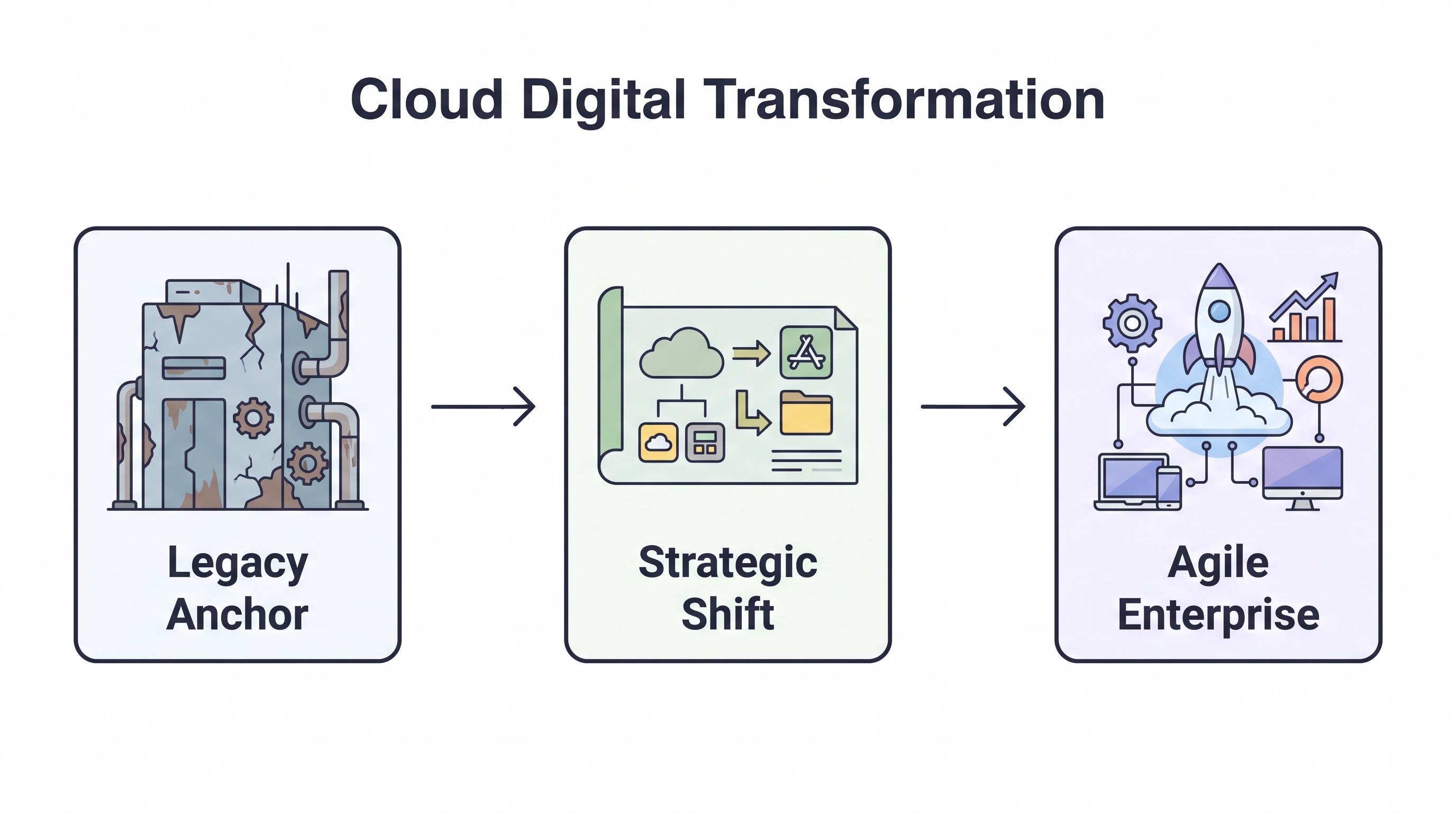
The Post-Migration Hangover
Between 2020 and 2024, thousands of enterprises executed massive "Digital Transformation" initiatives. They signed massive Enterprise Discount Programs (EDPs) with AWS or Azure, migrated thousands of virtual machines out of their on-premises data centers, and declared victory in a press release.
In 2026, many of those organizations are experiencing a severe post-migration hangover. They discovered that their cloud infrastructure is more expensive than their physical data center, their applications are just as slow to deploy, and their security posture is actually worse due to misconfigurations. They moved to the cloud, but they didn't transform.
This guide dissects the failure of the "lift-and-shift" strategy and outlines the technical and cultural prerequisites required to achieve genuine digital transformation.
The Lift-and-Shift Trap
The core failure of early digital transformation was treating the cloud as just another data center. A "lift-and-shift" migration takes a monolithic Java application running on a physical Windows server and moves it to a virtual Windows server (EC2) in the cloud.
This yields zero transformational value. The application is still a monolith. It still requires manual patching. It still cannot auto-scale. Worse, because it was designed for a static environment, it runs 24/7, ignoring the elasticity of the cloud and generating a massive, continuous bill. True transformation requires modernizing the architecture, not just changing the hosting provider.
Modernization Step 1: The Cloud Operating Model
You cannot operate a cloud environment using on-premises ITIL processes. If an engineer needs to submit a ServiceNow ticket and wait three weeks for a Change Advisory Board (CAB) to approve a firewall port change, the agility of the cloud is destroyed.
Transformation requires adopting a Cloud Operating Model (often referred to as Platform Engineering or SRE). The central IT team stops acting as a gatekeeper. Instead, they build a secure, automated platform. They provide developers with self-service APIs and pre-approved Terraform templates. The developer pushes code, the CI/CD pipeline runs automated security checks, and if it passes, the code goes to production immediately. Governance is enforced by automation, not by committee.
Modernization Step 2: Ephemeral Infrastructure
A modernized application assumes failure. (See the Chaos Engineering Guide). It does not rely on a single, massive server that has been manually configured over five years ("pet" servers).
Transformation requires migrating workloads to ephemeral infrastructure: Kubernetes containers or Serverless functions. When traffic spikes, the orchestrator spins up 50 identical containers. When traffic drops, it kills them. If a container fails, it is instantly replaced. This shift from static VMs to dynamic containers is the foundation of cloud reliability and cost efficiency.
Modernization Step 3: Financial Accountability (FinOps)
In the old data center, developers didn't care about the cost of a server; the CFO bought it three years ago. In the cloud, every line of code generates a micro-invoice.
As detailed in the FinOps Guide, digital transformation fails if engineering teams are not held accountable for their cloud spend. Organizations must establish strict resource tagging policies and utilize FinOps platforms to provide developers with real-time visibility into the cost per transaction of their specific microservices, empowering them to optimize their code.
Modernization Step 4: "Shift-Left" Security
The traditional security perimeter (the corporate firewall) does not exist in the cloud. Applications are distributed and frequently internet-facing. Security cannot be an afterthought tested immediately before launch.
Transformation requires DevSecOps. Vulnerability scanning, container image verification, and Infrastructure as Code (IaC) misconfiguration checks must be integrated directly into the developer's Git workflow. Security "shifts left," blocking vulnerable code from ever being compiled, rather than trying to patch it once it reaches production.
Key Takeaway
Moving virtual machines to AWS is a migration, not a digital transformation. Genuine transformation requires completely overhauling the operating model: adopting Platform Engineering for self-service deployments, refactoring monolithic applications into scalable containers or serverless functions, integrating continuous DevSecOps scanning into the CI/CD pipeline, and establishing a strong FinOps culture to hold engineering teams accountable for unit economics.
All in One Place
Atler Pilot decodes your cloud spend story by bringing monitoring, automation, and intelligent insights together for faster and better cloud operations.