
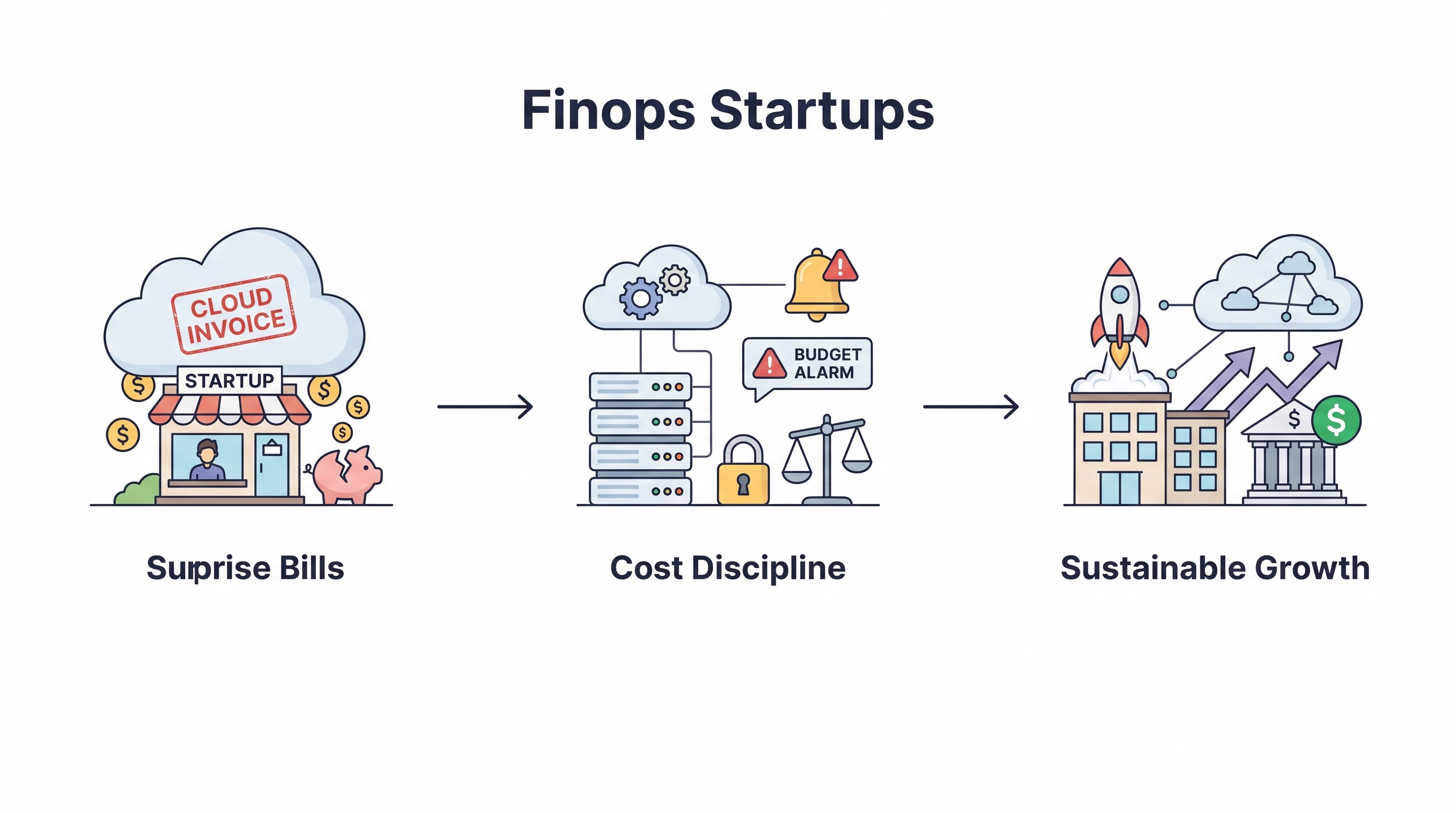
The Burn Rate Trap
For an early-stage startup, speed is the only metric that matters. Engineering teams are tasked with finding Product-Market Fit as fast as possible. Consequently, architecture is often hacked together, and cloud costs are completely ignored.
This works until the Series A funding hits. Suddenly, traffic scales 10x, and the AWS bill scales 50x because the infrastructure is fundamentally inefficient. The startup's "burn rate" skyrockets, and engineering velocity halts as the team is forced to spend six months refactoring the architecture just to survive financially. Implementing FinOps at Day 1000 is painful; implementing it at Day 1 is a strategic advantage.
This guide provides a pragmatic FinOps framework specifically designed for startups, ensuring financial discipline without slowing down product development.
The Illusion of Cloud Credits
The greatest enemy of startup FinOps is the $100,000 AWS Activate (or Azure/GCP equivalent) credit grant. Because the cloud is "free" for the first year, engineers develop incredibly wasteful habits. They spin up massive managed database clusters for simple staging environments and leave expensive GPU instances running idle.
When those credits expire on month 13, the startup is suddenly hit with a $15,000 monthly bill they cannot afford. Startups must manage their cloud environment as if the credits do not exist. Use the credits to extend your runway, not to fund sloppy architecture.
Step 1: Tagging from Day One
You cannot optimize what you cannot measure. As a startup grows from 2 engineers to 20, knowing exactly which feature or environment is driving the cloud bill is critical.
Implement a strict cloud tagging strategy immediately. You do not need a complex 50-tag taxonomy. You only need three mandatory tags: Environment (Prod vs. Staging), Service (e.g., Auth, Checkout), and Owner (e.g., BackendTeam). Enforce these tags via Infrastructure as Code (Terraform) or AWS Organizations Service Control Policies (SCPs) so that no resource can be deployed without them.
Step 2: Architecting for Cost (Serverless vs. Containers)
Startups frequently over-engineer their architecture. Do not deploy a complex, expensive Kubernetes cluster if you only have 500 daily active users. Kubernetes has a high baseline operational cost (the control plane) regardless of traffic.
For early-stage startups with unpredictable traffic, default to Serverless architecture (AWS Lambda, DynamoDB). Serverless scales to zero when you have no users, ensuring your bill remains microscopic in the early days. If the startup hits hyper-growth and the per-request serverless premium becomes too high, you can refactor to containers later. (See the Migration Guide).
Step 3: Establishing Unit Economics Early
Venture Capitalists in 2026 are heavily focused on profitability, not just raw growth. They will ask for your Cloud Unit Economics during the Series B pitch.
You must know the exact "Cost per Tenant" (for B2B SaaS) or "Cost per Transaction" (for B2C). If your application costs $5 to acquire a user, but the cloud infrastructure to serve that user costs $6 a month, your business model is fundamentally broken. By establishing these metrics early, the CEO can make informed pricing decisions based on the actual COGS (Cost of Goods Sold).
Step 4: The Minimalist Tooling Stack
Startups do not need to purchase massive, six-figure enterprise FinOps platforms. However, they cannot rely solely on the native AWS Billing console either.
Implement lightweight, automated tooling. Set up AWS Cost Anomaly Detection to send a Slack alert if the daily spend spikes unexpectedly (preventing a developer loop from draining your credits overnight). Utilize open-source tools (like Infracost) in your GitHub Actions pipeline to show developers the estimated cost of their Pull Requests before they merge them.
Key Takeaway
Startups must not let free cloud credits mask inefficient architecture. Establish a baseline FinOps culture immediately by enforcing mandatory resource tags, architecting for scale-to-zero using Serverless technologies, and calculating the Cost per Tenant early. By setting up automated anomaly alerts to Slack, startups can protect their runway from accidental billing spikes while maintaining high engineering velocity.
All in One Place
Atler Pilot decodes your cloud spend story by bringing monitoring, automation, and intelligent insights together for faster and better cloud operations.