
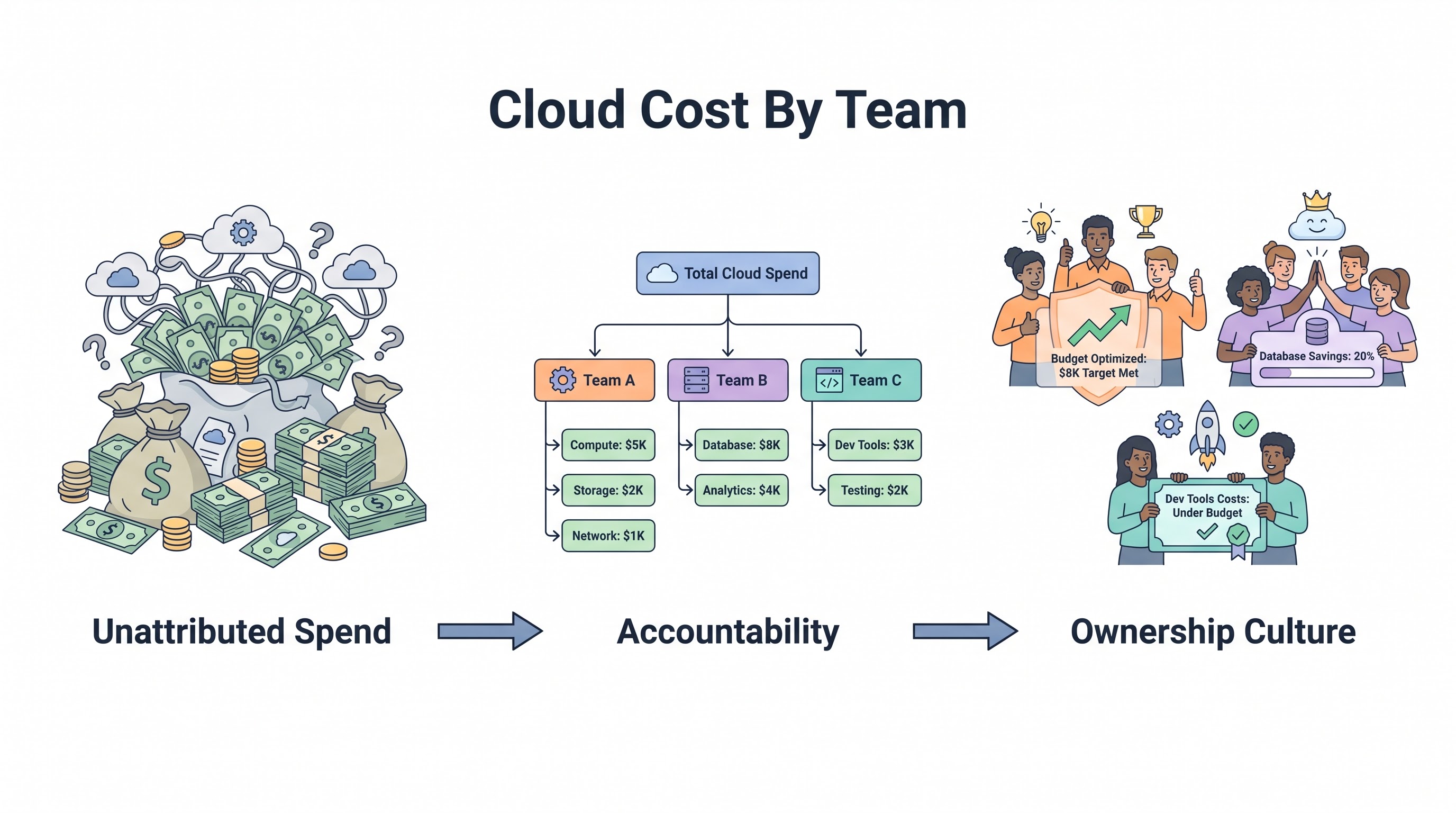
The Monolithic Bill
If you receive a $100,000 monthly AWS bill and the only detail provided is "EC2: $60,000" and "RDS: $40,000," you have no ability to optimize it. You do not know if the marketing team's analytics project is burning cash or if the core e-commerce platform is highly efficient.
The foundational pillar of Cloud Financial Operations (FinOps) is Attribution. You must be able to slice the monolithic cloud bill into distinct pieces owned by specific engineering or product teams. If an engineering manager does not believe the cost data accurately reflects their team's specific usage, they will completely reject any optimization initiatives. This guide provides the tactical roadmap for achieving 100% cost attribution.
The Goal of Attribution
The goal is not just accounting; the goal is behavioral change. When you track cloud cost by team, you establish accountability. If the "Checkout API" team knows their exact monthly spend is tracked on a public executive dashboard, they will naturally investigate why their database costs spiked 20% over the weekend, rather than ignoring it as a "central IT problem."
Step 1: The Tagging Taxonomy
As detailed in the Cloud Tagging Strategy Guide, attribution relies almost entirely on metadata tags applied to cloud resources.
You must define a strict, enterprise-wide taxonomy. For cost attribution, the most critical tag is Owner or Team (e.g., Team: MobileBackend). Secondary tags like Service (e.g., Service: NotificationEngine) and Environment (e.g., Environment: Production) provide the necessary granularity to calculate unit economics.
Step 2: Automated Enforcement
A tagging policy written in a Wiki document is useless. Developers will forget to tag resources, or they will misspell the tags (e.g., Team: Mobile vs team: mobile_backend), destroying the integrity of the billing reports.
Tagging must be automated and enforced. 1. Infrastructure as Code: Enforce tags at the Terraform module level. 2. Reactive Remediation: Use tools like AWS Config or Cloud Custodian to scan for untagged resources. If a developer spins up an EC2 instance without an Owner tag, the automation instantly terminates the instance and sends a Slack message explaining why.
Step 3: The Shared Cost Problem (K8s and Databases)
The most complex aspect of attribution is shared infrastructure. If six different engineering teams all deploy their microservices into a single, massive Amazon EKS cluster, standard AWS resource tags fail. The tags only show the total cost of the EC2 worker nodes, not the cost of individual pods.
To attribute shared costs, you must deploy specialized observability tools (like Kubecost or OpenCost). These tools monitor the exact CPU and memory consumption of every pod within a specific Kubernetes Namespace. They then mathematically split the total EC2 node cost and allocate it proportionally to the teams that own those specific Namespaces.
For shared databases (e.g., a massive Snowflake data warehouse), attribution must be calculated based on query execution time or bytes scanned per user role.
Step 4: Showback vs. Chargeback
Once you have accurate attribution data, you must choose how to present it.
Showback: The FinOps team creates a dashboard showing each team their exact cloud spend. Central IT still pays the bill, but the teams have visibility. This is the recommended starting point; it generates awareness without political friction.
Chargeback: The actual financial budget is transferred to the engineering teams. If the "Checkout API" team spends $10,000 on AWS, that money is deducted from their specific departmental budget. Chargeback is highly effective at forcing optimization, but requires an extremely mature, highly trusted tagging system, or teams will fight bitterly over the accounting. (See the Chargeback Guide).
The Alternative: Account Segmentation
If your organization cannot establish a reliable tagging strategy, the fallback is Account Segmentation (e.g., AWS Organizations). Instead of putting all teams in one AWS account and relying on tags to separate the bill, you give each team their own completely isolated AWS account (or Azure Subscription).
The billing engine natively separates costs by account. The "Mobile Backend" AWS account clearly belongs to the Mobile team. While this simplifies billing attribution immediately, it significantly increases the complexity of network routing and security governance across dozens of separate accounts.
Key Takeaway
Without accurate cost attribution, FinOps is impossible. Organizations must implement a strict, automated tagging taxonomy enforced via Infrastructure as Code to slice the monolithic cloud bill by engineering team. For modern architectures, specialized tools must be deployed to mathematically distribute the costs of shared Kubernetes clusters. Begin with a "Showback" model to build trust in the data before transitioning to a strict financial "Chargeback" model.
All in One Place
Atler Pilot decodes your cloud spend story by bringing monitoring, automation, and intelligent insights together for faster and better cloud operations.