
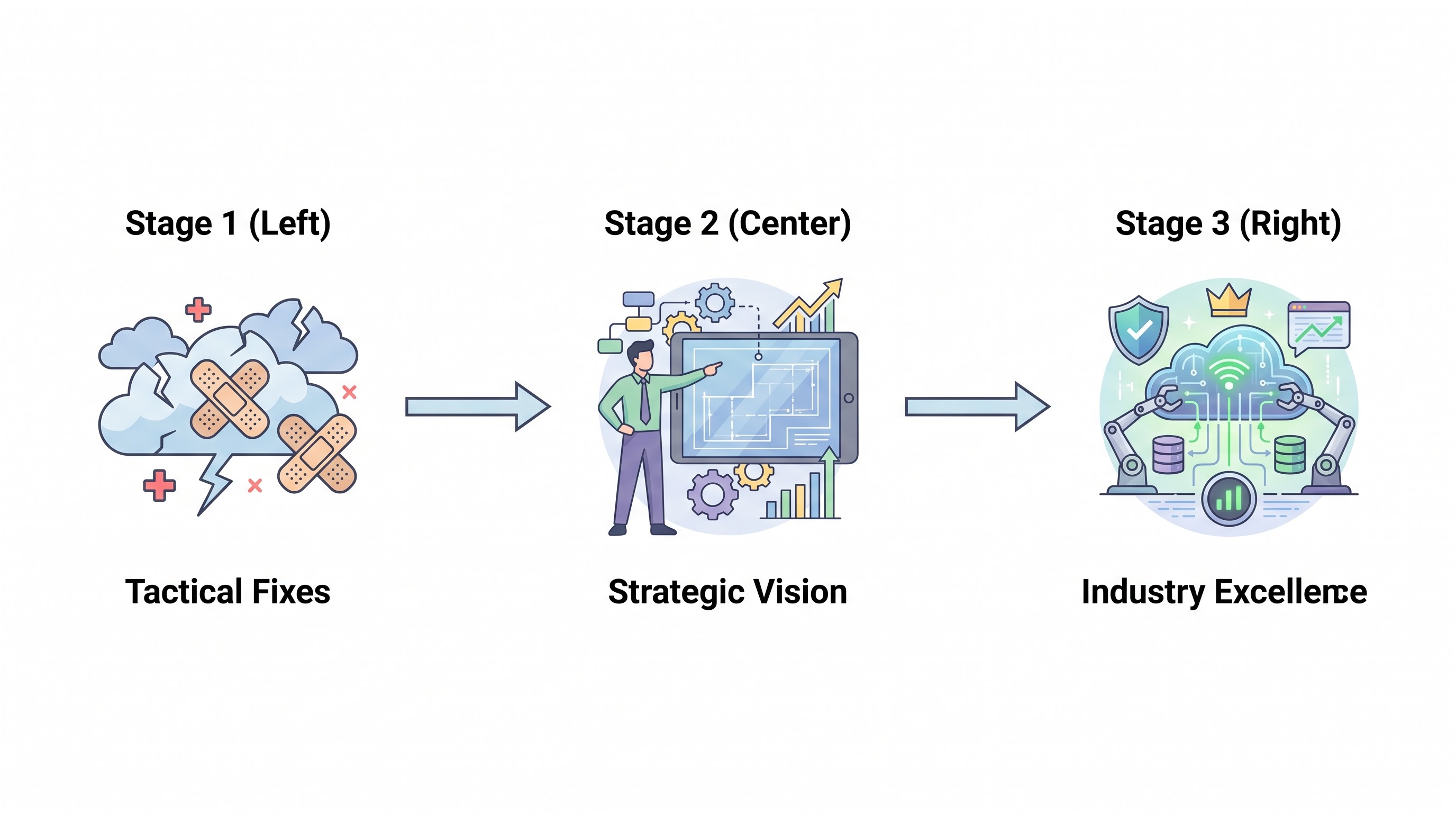
The End of the Ticket Queue
For decades, the standard operating procedure for IT infrastructure was the ticket queue. A developer needed a database; they submitted a Jira ticket to the operations team. Two weeks later, after security reviews and capacity planning, the database was provisioned. In the era of the public cloud, this model is not just slow; it is a competitive disadvantage.
The speed of modern software delivery demands an operating model where infrastructure is instant, elastic, and invisible to the developer. This guide explores the strategic evolution of Cloud Operations, highlighting the death of traditional sysadmin workflows and the rise of Platform Engineering and autonomous infrastructure.
The Platform Engineering Shift
The most significant organizational shift in modern cloud management is the transition to Platform Engineering. The operations team no longer manages servers; they build a platform.
The goal of Platform Engineering is to pave a "golden path" for developers. The platform team builds an internal developer portal (IDP) powered by pre-approved, highly secure Terraform modules. When a developer needs a database, they click a button in the portal. The platform automatically provisions the RDS instance, attaches the correct IAM roles, injects the credentials into the CI/CD pipeline, and applies the required FinOps tags. The operations team becomes a software development team whose primary customer is the internal software engineer.
Treating Infrastructure as a Product
Platform Engineering requires a product mindset. The platform must be compelling enough that developers want to use it, rather than feeling forced to use it by compliance mandates.
This means the operations team must conduct user research with their engineers, measure the "Time to First Deployment," and continuously iterate to remove friction. If the platform is too restrictive, developers will build "shadow IT" architectures to bypass it, destroying security and cost governance.
The Rise of Autonomous Operations
As the platform matures, operations shift from automated to autonomous. As discussed in the Intelligent Automation Guide, human engineers cannot manually manage the complexity of thousands of ephemeral Kubernetes pods.
Cloud operations will increasingly rely on AI-driven control planes. These autonomous agents will dynamically scale infrastructure, seamlessly route traffic around failing Availability Zones, and autonomously execute security patches without human intervention. The operator's job shifts from executing the task to defining the constraints and guardrails within which the AI agent operates.
The Changing Role of the SRE
Site Reliability Engineering (SRE) will remain critical, but its focus will elevate. SREs will spend less time writing Bash scripts to restart failed services and more time designing resilient architectures that prevent failures entirely.
They will focus on defining Service Level Objectives (SLOs) aligned with customer experience, executing massive Chaos Engineering experiments to proactively identify systemic weaknesses, and tuning the AI agents to ensure autonomous remediations do not trigger cascading failures.
Alignment with Business Value (FinOps)
Historically, operations was viewed as a cost center. In the autonomous era, Cloud Operations becomes a primary driver of business value.
By integrating FinOps directly into the platform, the operations team ensures that infrastructure scales not just based on traffic, but based on profitability. If an operation team can re-architect a data pipeline to reduce the cost-per-transaction by 20%, they directly impact the company's gross margins, elevating the operations leader to a strategic partner for the CFO.
Key Takeaway
The era of manual cloud operations and ticket queues is over. Organizations must transition to a Platform Engineering model, treating internal infrastructure as a product designed to maximize developer velocity. By building self-service platforms, embracing autonomous AI-driven automation, and deeply aligning operations with FinOps unit economics, the modern Cloud Operations team transforms from a back-office cost center into a strategic business enabler.
All in One Place
Atler Pilot decodes your cloud spend story by bringing monitoring, automation, and intelligent insights together for faster and better cloud operations.